
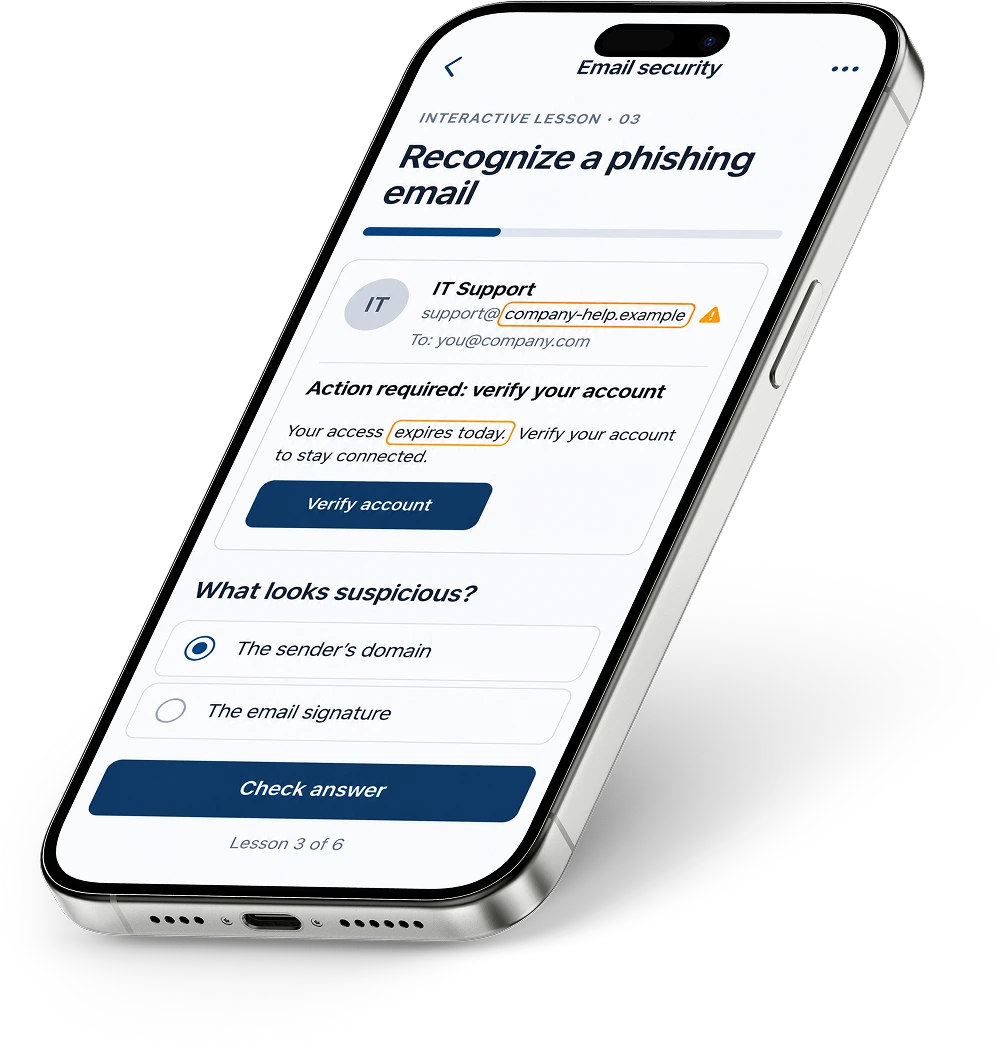

Cybersecurity Education Platform
Building Search Features With AI in a KMP App
Building Search Features With AI in a KMP App
Less Implementation Time
Search Flows to Validate
New Regressions in Tested Flows
What Is the Cybersecurity Education Platform?

The project is a mobile cybersecurity training application serving individual learners and enterprise learning programs. Its Kotlin Multiplatform architecture shares business logic and ViewModels across Android and iOS.
Aetherius contributed to feature development, API integration, bug fixing, and ViewModel testing within the existing codebase. Our engineer used AI to locate relevant implementation patterns, generate feature structures, and propose tests, then reviewed the changes and checked behavior before submitting pull requests.
The client and product name are confidential.
Challenges and Solutions
Several search flows required the same underlying behavior: query handling, debounce, loading, empty and error states, results, and navigation. Each implementation needed to follow the project’s MVI architecture and connect to the appropriate repository and API.
Our engineer used an existing search flow as a reference for the AI agent to generate the Intent, State, Event, and ViewModel structure, dependency-injection wiring, and initial tests. The engineer reviewed API mapping, corrected implementation details, and checked the flow in a UAT build. This reduced repetitive setup and the effort spent finding the right pattern in the codebase.


Feature development and debugging involved empty responses, missing fields, and API errors. Search and progress-related issues also required careful interpretation of the API contract, because a plausible local change could leave the underlying problem unresolved.
Our engineer supplied the agent with ticket requirements, API definitions, and relevant responses or logs. Proposed changes were checked against the expected behavior, with manual validation of applicable error and navigation scenarios. Changes to shared logic were also reviewed for their effect on the contract consumed by iOS.
AI-generated tests needed to follow the project’s ViewModel testing conventions and cover the behavior described in the ticket. Passing tests alone did not establish that the original bug or relevant failure scenarios were covered.
Project-specific instructions guided test generation. Our engineer compared the proposed tests with the requirements, requested revisions or added assertions where coverage was insufficient, and ran the shared-module unit and ViewModel tests. Gradle builds and manual device checks provided additional validation before review.


What Keeps
the Project Running


Other Projects We’ve
Worked On





Tell us about your project
You’re one step away from getting the right developers.

"Aetherius' work achieved the correct functionality, satisfying the client's expectations, and planning to collaborate on a larger project in the future."
