One developer is currently available to jump onto a project!
This Is How Our Engineers Build KMP Apps
This Is How Our Engineers Build CMP Apps
Flutter, React Native, or Native? Dubai's Biggest Bank Says It Doesn't Matter
If you've spent any time in mobile app development, you've had this argument. Flutter or React Native? Native or cross-platform? Every team has an opinion, and most of them are convinced they're right.
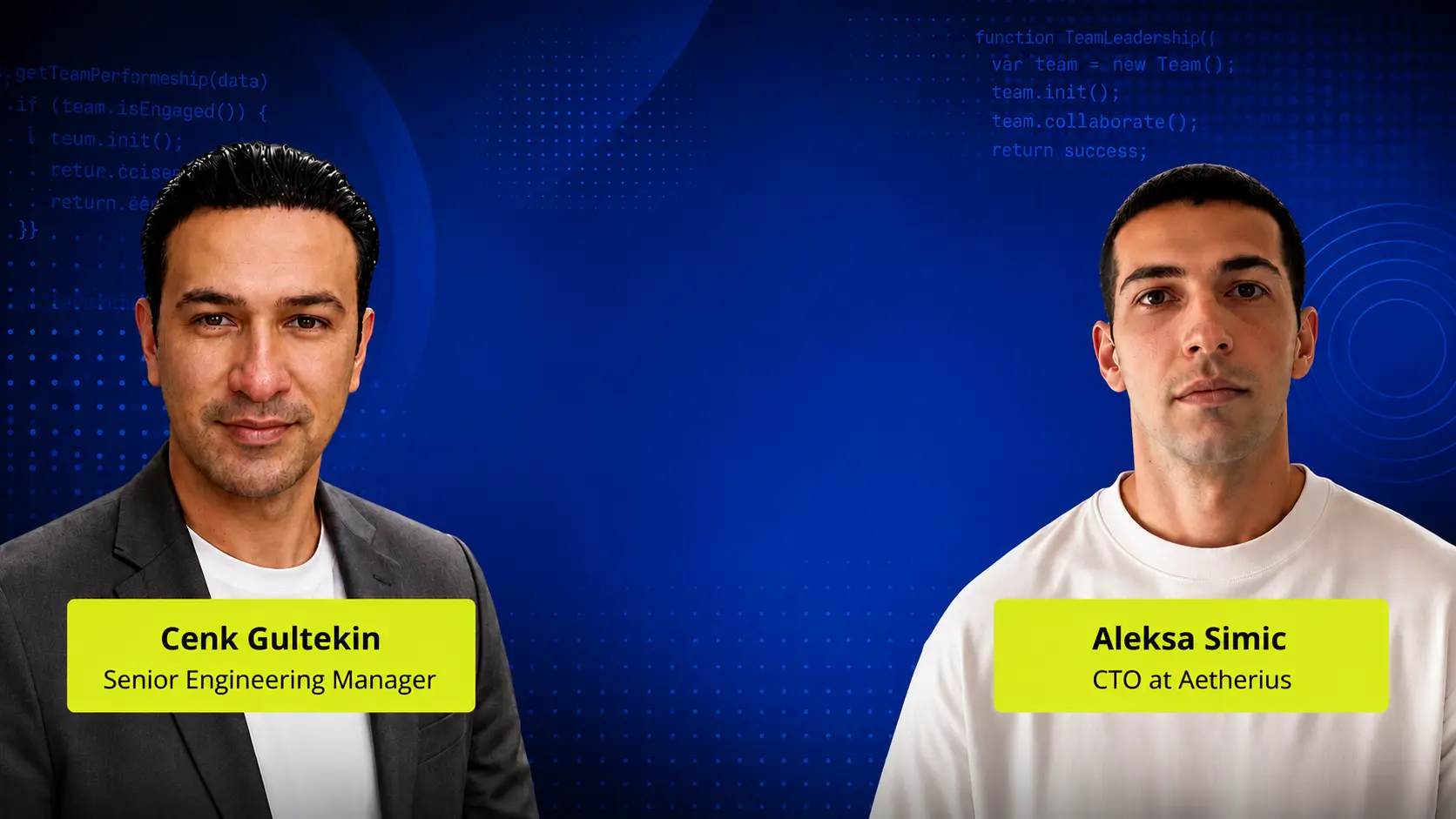
So it's worth pausing on what Cenk Gultekin had to say about it. Cenk is a senior engineering manager at Emirates NBD, one of the largest banks in the UAE, working with a large team of mobile engineers. He also founded Mobile Guild, a UAE-based community that has grown to 550 members from 220 different companies since its first event less than a year ago. When our CTO of Aetherius, Aleksa Simic, sat down with him for a podcast conversation, one of the first things Cenk made clear was this: the technology stack is not where the real decision-making energy should go.
We talked to him about engineering leadership, scaling teams, and AI, and you can watch the full conversation on our YouTube channel if you want to hear it straight from him. You'll also find more conversations like this one on our Webinars & Podcasts hub. Below, we've pulled out what he had to say about mobile app development trends in the UAE, and why "which framework is best" might be the wrong question entirely.
The Real Data Behind UAE's Mobile Tech Stack Choices
Cenk didn't need to run a formal study to know what's happening across the UAE mobile scene, Mobile Guild's events do that work for him. At the community's most recent event, nearly 300 people registered from a pool of 550 members representing 220 companies, spanning startups, fintechs, and some of the region's largest banks.
When Aleksa asked him directly what technology stack UAE companies are leaning toward, Flutter, React Native, native, something else, Cenk's answer was: "the answer is everything." There's no single winner.
Small companies tend to gravitate toward newer technologies. A friend of his, running mobile engineering at a company in Abu Dhabi, is actively using Kotlin Multiplatform (KMP). He knows small enterprise financial companies that have used KMP for the past two years. Meanwhile, some of the biggest banks in the region are running React Native, and others are fully committed to native iOS and Android.
In other words: if you were hoping the UAE market had converged on one clear answer for mobile app development, it hasn't.
Flutter vs React Native vs Native: What Drives the Decision
Rather than a single trend, what emerged from the conversation is a set of patterns tied to company size, risk tolerance, and existing technical maturity.
When Companies Choose Native App Development
Cenk pointed to large banks, including his own, that continue to invest in fully native iOS and Android development. At the scale of hundreds of engineers and mission-critical financial products, native development gives teams tighter control over performance, security, and platform-specific behavior, even if it means maintaining two separate codebases.
When React Native Development Makes Sense at Scale
Somewhat counterintuitively, Cenk noted that some of the UAE's biggest banks are also running React Native in production. This challenges the assumption that cross-platform frameworks are only for smaller teams or early-stage products, with the right engineering discipline, React Native can support large, complex, regulated applications too.
Where Flutter App Development Wins for Startups and Fintechs
Smaller companies tend to favor what he called "gross technologies", faster-moving, more modern stacks that let lean teams ship quickly. Flutter fits that pattern well, particularly for startups and fintechs that need to move fast without the overhead of managing two native codebases, which is also why so many early-stage teams pair it with MVP development to validate an idea before committing to a larger build.
KMP: The Dark Horse Enterprise Teams Are Testing
Kotlin Multiplatform came up more than once as a technology quietly gaining traction, not just among startups, but inside enterprise financial companies that have been using it for a couple of years already. It's a signal worth watching for teams weighing their next mobile app development investment, especially those currently on native who are exploring what it takes to migrate from native to cross-platform without a full rebuild.
Why the "Best" Mobile Development Framework Is the Wrong Question
Here's the part of the conversation that mattered more than any framework comparison. Cenk was clear that the real risk to a mobile engineering team has very little to do with which technology sits underneath the product.
His argument: no matter what stack you choose, if you don't have a strong engineering mindset, clear standards, and a team that's aligned on what "good" looks like, the framework won't save you. He put it plainly when discussing how he evaluates engineers, personality and mindset come before technical perfection. Someone who's curious, still reading, still learning, and comfortable being measured will outperform a technically flawless engineer who's stopped growing.
That same logic applies to technology decisions. A team with excellent engineering discipline can build something reliable and fast in React Native, Flutter, KMP, or fully native, whether it's built in-house or through cross-platform development services. A team without that discipline will struggle no matter what's in their tech stack.
If you're unsure which direction fits your product, that's exactly the kind of question “React Native vs Flutter in 2026: Maintainable Code or Future Tech Debt?” is meant to answer before you write a single line of code.

What Matters More Than the Tech Stack When Scaling a Mobile Engineering Team
Cenk has lived through this firsthand. He scaled his mobile engineering organization over nine years, and he was candid about what actually gets harder as a team grows, and it isn't the framework. It's also why many companies going through this stage choose to extend their team with senior engineers rather than absorb the full hiring and onboarding cost themselves.
Some of the real challenges he described:
- Build time and pipeline management.
As Android projects grow, build times balloon. Buying more expensive hardware helps temporarily, but it isn't a permanent fix, modernization is. - Code review at scale.
When you have three engineers, you can just ask someone directly to review a pull request. At 100+ engineers, that informal system breaks down completely, and you need real process and metrics. - Consistent metrics, not vanity metrics. Cenk pushes his teams to track things like crash-free rate (targeting 99%+), API response time, and DORA metrics, how long it actually takes to fix a bug and ship it to production. He was blunt that some companies claim to have "automation" that's really just manual testing with extra steps.
- Absorbing stress rather than passing it down.
As teams scale, leaders have to filter pressure from above rather than transmitting it directly to engineers, something Cenk considers core to effective engineering leadership.
None of this is about Flutter, React Native, or native. It's about whether the organization has the discipline to measure, communicate, and hold a standard as headcount grows.
How AI Is Changing the Native vs Cross-Platform Debate
The AI angle adds an interesting wrinkle to the whole framework debate. Cenk's take was that AI is rapidly closing the gap between beginner and advanced engineers, and increasingly, the differentiator isn't which language or framework someone specializes in, but how well they can orchestrate multiple AI tools together.
He described the kind of candidate he'd hire today: someone who knows several different AI coding tools, understands design-focused MCPs, and has already shipped proof-of-concept apps using them, regardless of whether their primary background is Flutter, React Native, or native development. In his view, engineers who avoid AI out of fear are the ones putting themselves at risk, not the ones betting on a particular framework.
That reinforces the same underlying point from earlier: the technology choice matters far less than the team's ability to adapt, learn continuously, and hold a high bar for quality, whether that quality bar is enforced by a human code reviewer or an AI-assisted one.
Choosing the Right Mobile Development Partner for Your Stack
Don't let the “Flutter vs React Native vs Native” debate distract you from the decisions that actually determine whether your mobile app succeeds, team quality, engineering culture, and how rigorously you measure performance.
At Aetherius, we work across all of these stacks, because the right choice genuinely depends on your product, your team's maturity, and your growth stage, not on which framework is trending this year.
Whether you need a dedicated Flutter development team, React Native engineers who can operate at enterprise scale, or a native iOS/Android team for a performance-critical product, you can see how this plays out in practice across our portfolio of delivered projects.
If you're evaluating your mobile app development options or thinking about how to scale an existing mobile engineering team without losing quality, get in touch with Aetherius to talk through what actually fits your situation.
And if you want to hear Cenk's full conversation with Aleksa, including his thoughts on hiring, engineering metrics, and where AI is headed next, you can watch the complete episode on our YouTube channel, or browse more sessions on our Webinars & Podcasts hub.
Want more of this? Aleksa shares daily takes on mobile engineering, KMP, and building Aetherius on his LinkedIn, worth a follow if you want the shorter, day-to-day version of these conversations.
And if you'd rather get it straight to your inbox, subscribe to the Aetherius newsletter to stay on top of mobile development news, tech updates, and insights from our CTO.
to Build Your App?