
One developer is currently available to jump onto a project!
This Is How Our Engineers Build KMP Apps
This Is How Our Engineers Build CMP Apps
How AI Is Reshaping the Development Process

In our latest podcast, our CTO, Aleksa Simic, and AI consultant Charana Amarasekara discussed how AI is changing product development, how engineers use it daily, and what teams need to understand before adopting it.
We’ve broken down the key insights below.
Question 1: What does AI actually look like in product development today?
AI app development is no longer just an experimental feature or something reserved for large tech companies.
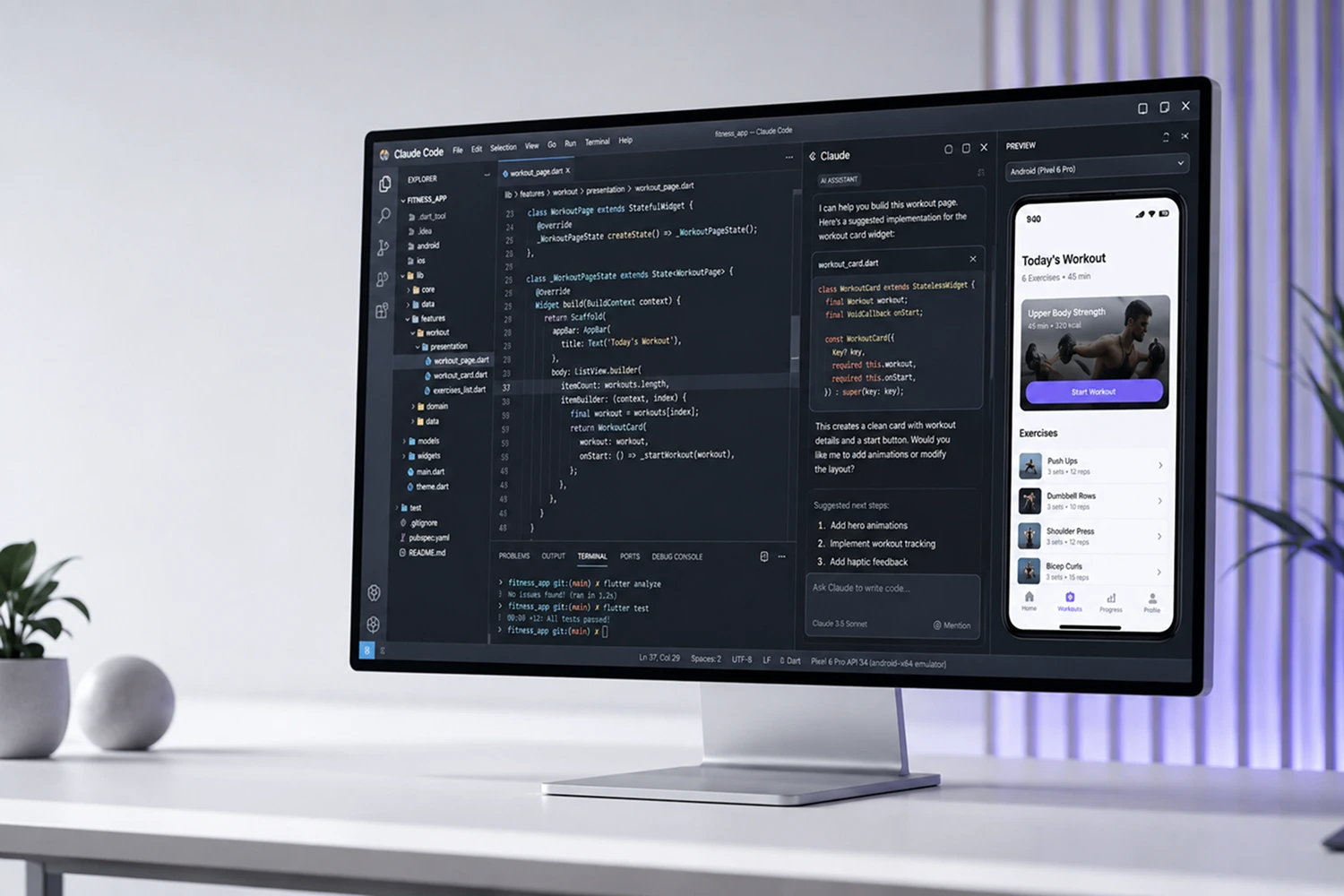
Today, it is embedded directly into the way products are built. Teams use AI across the entire development process, from writing and refining code to understanding user behavior and shaping product decisions. It often works quietly in the background, assisting developers while they code, helping them resolve issues faster, and even suggesting improvements in real time.
Instead of starting from scratch, developers now begin with AI-generated drafts and iterate from there. This changes the pace of development significantly. Tasks that previously required deep research or repetitive effort can now be handled much faster, allowing teams to move quickly from idea to implementation. This is especially valuable in early-stage products, where speed and experimentation are critical.
AI is not replacing developers, but it is reshaping their role. It acts as a productivity layer that reduces time spent on routine work and opens up space for more meaningful decisions. Developers are no longer focused only on writing code. They are increasingly involved in thinking about the product itself, how features should work, and how users will interact with them.
The biggest shift is not just in efficiency, but in perspective. With AI handling a portion of the execution, developers can focus more on problem-solving, product logic, and overall user experience. In that sense, AI is not just another tool in the stack, it is changing how modern product development is approached.
Question 2: How is AI changing the daily workflow of developers?
One of the most noticeable changes AI brings is the shift in how developers spend their time throughout the day.
Instead of manually handling every step of the process, developers now work in a more iterative way. AI often acts as a first pass, whether it’s writing an initial version of code, suggesting fixes, or helping structure a solution. From there, the developer reviews, adjusts, and improves the output. This creates a faster feedback loop and reduces the time spent on repetitive or predictable tasks.
As a result, everyday workflows feel less fragmented. There is less context switching between searching for solutions, reading documentation, and implementing code. Much of that process is compressed into a more continuous flow where developers can move from idea to execution without as many interruptions.
This also affects how teams collaborate. With faster iteration cycles, decisions can be tested and validated more quickly, which shortens the gap between development and product feedback. Developers are able to explore multiple approaches in less time, making the overall process more flexible and experimental.
However, this increased speed comes with a different kind of responsibility. Developers need to be more critical of the output they receive. Understanding the code, validating logic, and ensuring long-term maintainability become even more important when part of the work is generated.
In practice, AI doesn’t remove work, it changes its nature. The focus shifts from writing everything manually to guiding, evaluating, and refining what AI produces. This leads to a workflow that is faster, but also more dependent on strong engineering judgment.
Question 3: Can AI-generated code be trusted?
AI-generated code can be incredibly useful, but it should not be treated as something that can be trusted without question.
In many cases, it provides a strong starting point. It can speed up development, reduce repetitive work, and help developers move past blockers more quickly. For simple tasks or well-defined problems, the output can often be surprisingly accurate and usable with minimal changes.
However, the challenge appears when the context becomes more complex. AI does not fully understand the architecture of a specific product, the long-term goals of a system, or the edge cases that may exist. Because of that, it can generate code that looks correct on the surface but introduces subtle issues, whether in logic, performance, or security.
This is why human oversight remains essential. Developers need to review, test, and fully understand any code that is generated before using it in production. The responsibility does not change, even if the way code is written does.
In practice, AI works best as a co-pilot. It helps accelerate development, but the final decisions and accountability still belong to the developer. Trust in AI-generated code should be built on validation, not assumption.
Question 4: How should companies think about AI in their products?
Many companies approach AI with the wrong mindset, treating it as a feature to add rather than a problem to solve.
The real value of AI development comes from how it is applied, not from the fact that it is used. Simply adding AI to a product does not guarantee a better user experience or a stronger product. In some cases, it can even add unnecessary complexity without delivering real benefits.
A more effective approach is to start with the product itself. Understanding user needs, identifying friction points, and defining clear problems creates a much stronger foundation. From there, AI can be introduced where it genuinely improves the experience, whether by automating workflows, providing insights, or enabling new types of interactions.
When used correctly, AI becomes part of the product’s core value rather than an add-on. It enhances what already exists instead of trying to justify its presence.
For companies, this also means thinking beyond implementation. It involves considering how AI fits into the overall product strategy, how it will evolve over time, and how it will be maintained. Successful use of AI is not just about technology, but about making better product decisions.

Question 5: What is the biggest mistake teams make when using AI?
The biggest mistake teams make when using AI is relying on it too much without fully understanding the output. It’s common for developers early in their careers these days.
Because AI can generate results quickly and often with high confidence, it creates a false sense of reliability. Teams may start to trust the output without questioning it, especially when it appears correct at first glance. Over time, this can lead to deeper issues, such as flawed logic, inconsistent architecture, or hidden bugs that are difficult to trace.
The problem is not the use of AI itself, but the lack of critical thinking around it. When teams treat AI as a source of truth rather than a tool, they lose control over the quality of their product. This is particularly risky in complex systems, where small mistakes can have long-term consequences.
Using AI effectively requires balance. It should be used to accelerate development and support decision-making, but not replace understanding. Developers still need to review what is generated, validate assumptions, and ensure that every part of the system aligns with the overall architecture and product goals.
In the end, AI does not reduce responsibility. It shifts it. Teams that recognize this are able to use AI as a powerful advantage, while those that don’t often face issues later in the development process.
Question 6: What does the future of AI in development look like?
AI is expected to become a standard part of every development workflow, rather than something optional or experimental.
As tools continue to improve, they will handle more complex tasks and integrate more deeply into the way products are built. Developers will rely on AI not only for writing code, but also for making decisions, exploring different approaches, and understanding the impact of those decisions more quickly.
However, this does not mean that the role of developers will become less important. On the contrary, it will evolve. The focus will shift away from purely writing code toward solving problems, designing better systems, and thinking more about the product as a whole.
As AI takes over repetitive and time-consuming tasks, developers will have more space to focus on areas that require human judgment. This includes defining product logic, improving user experience, and making decisions that align with business goals.
In this sense, the future is not about AI replacing developers, but about developers who know how to use AI effectively. Those who adapt will be able to build faster, experiment more, and create better products, while those who ignore it may struggle to keep up with the pace of change.
This is where we covered some of the main topics from our podcast with Charana Amarasekara, focusing on how AI is shaping modern product development and changing the way developers work.
Throughout the conversation, we explored practical insights, real-world experiences, and the challenges that come with adopting AI in everyday workflows. From AI-generated code to its impact on decision-making and product strategy, the discussion goes much deeper than what is covered here.
If you found this interesting and want to dive deeper into the full conversation you can watch the entire podcast below.
to Build Your App?