
One developer is currently available to jump onto a project!
This Is How Our Engineers Build KMP Apps
This Is How Our Engineers Build CMP Apps
Kotlin Multiplatform in 2026: What Changed Since 2025 and Why More Teams Are Adopting KMP

In 2026, the question isn’t “Is Kotlin Multiplatform (KMP) ready?”.
It’s “How quickly can we adopt it?”
After years of development and real-world testing, KMP has matured into a reliable solution for cross-platform apps. Teams exploring KMP for new projects, migrating from native apps, or weighing cross-platform options need to understand what changed since 2025, why these updates matter, and how they can reduce development time and costs, making KMP an increasingly attractive choice for mobile teams.
What Changed with Kotlin Multiplatform in 2025?
1. Swift Export is now enabled by default in Kotlin Multiplatform
You already know I am a big supporter of this framework, and one of the biggest KMP pain points was that Kotlin code was previously converted into Objective-C. The problem is that Objective-C has a completely different syntax and naming style. So, the generated code often looked weird and unnatural to Swift developers. For example, instead of a clean Swift call like:
.png)
You’d get something like:
.png)
which doesn’t really feel like native Swift code, right? Now, with Swift Export, Kotlin code is translated directly into pure Swift, without that Objective-C layer in between. That means you can call Kotlin functions in Swift just like native Swift code:
It’s still experimental, but it’s a huge leap forward for Kotlin Multiplatform developers.
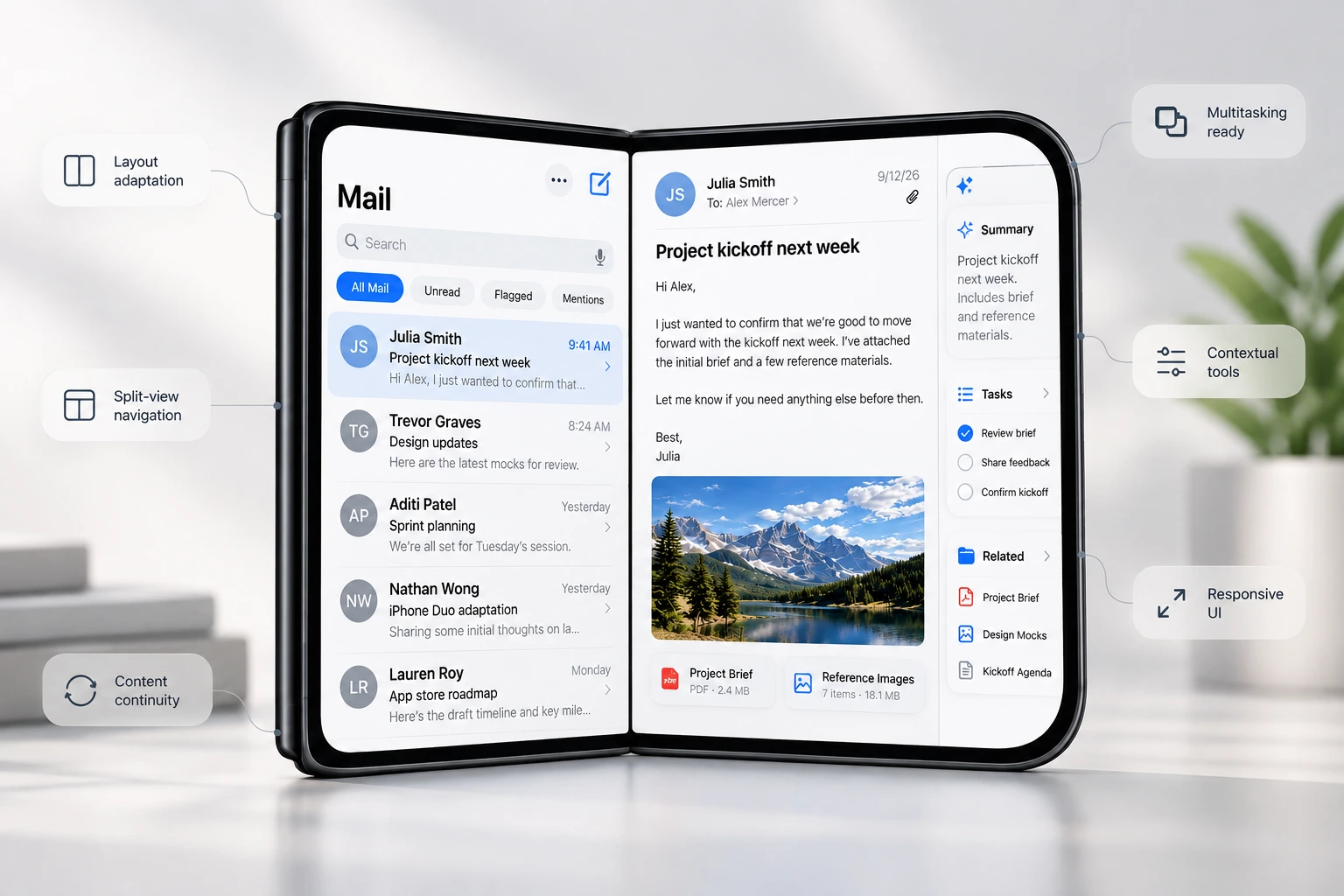
In 2025, Compose Multiplatform became much more stable on iOS. Before, teams hesitated to share UI code across platforms because it felt risky. With the improvements, sharing UI and business logic between Android and iOS became much easier, which is exactly what enterprises need when looking to speed up development and reduce duplicate work.
2. JetBrains roadmap becomes clearer
JetBrains published a clearer roadmap for KMP, showing priorities, upcoming features, and tooling improvements. This made it easier for CTOs and agency leads to trust that KMP is here for the long term, no more “experimental tech” fears. Clear direction also helps when planning budgets and estimating project timelines.
3. Real-world production adoption
Companies started showing practical use cases. For instance, H&M added a shared KMP layer for feature flag handling across iOS and Android, which worked so well that they’re expanding it. Seeing big brands succeed with KMP helps other teams justify adoption and plan step-by-step migrations from native apps.
4. Ecosystem and community growth
The community around KMP kept growing; more libraries, tutorials, guides, and migration examples appeared. This made it easier to estimate effort, avoid mistakes, and integrate KMP into real-world projects. By the end of 2025, KMP was no longer “experimental”; it had become a practical option for production apps.
Why the 2025 KMP Updates Matter for Enterprises
From my experience working with agencies and enterprise clients, the 2025 KMP improvements weren’t just “nice to have”, they changed how teams plan, budget, and execute mobile projects.
Here’s what I’ve seen firsthand:
1. Less risk = faster buy-in
Before 2025, when I suggested KMP to clients, the reaction was often: “Is this really production-ready?” With Compose Multiplatform getting stable iOS support and JetBrains publishing a clear roadmap, that hesitation is largely gone. Teams are now willing to approve KMP much faster, which means you can pitch projects confidently and clients are much more open to exploring shared Kotlin layers.
In a recent webinar, I discussed the top 10 reasons iOS developers are hesitant to adopt Kotlin Multiplatform, alongside a Staff Engineer from Monzo with over 8 years of iOS experience across fintech, consulting, and crypto projects. You can check the key takeaways!
2. Fewer surprises when estimating budgets
One of the biggest headaches I’ve had as a CTO partner is clients getting shocked by hidden costs. The 2025 updates, plus public case studies from companies like H&M, Netflix and others adopting KMP, make it much easier to estimate costs for adding KMP to an existing native app or for greenfield builds.
From my experience, having this clarity upfront not only speeds up decision-making but also builds trust: clients see a predictable budget and feel confident moving forward.
3. Hiring and team strategy shifts
KMP today is no longer just about shared business logic; it’s starting to cover UI modules too. In practice, this means you need engineers who understand both shared Kotlin code and platform-specific UI.
I’ve worked with teams that struggled to find this skill set internally, which is exactly why team extension or specialized KMP developers can be a smarter, faster, and more cost-effective choice than expanding your internal team.
4. Step-by-step migration paths
I’ve seen companies do it, and I've done it as well: the best way to adopt KMP isn’t a full rewrite, it’s incremental. Adding layers for feature flags, analytics, or business logic first allows teams to migrate step by step while keeping the rest of the native app intact. This approach drastically reduces risk and ensures apps keep running smoothly while teams learn KMP.

Kotlin Multiplatform in 2026: Predictions and Opportunities
From what I’ve seen working on real client projects, this isn’t a trend that will slowly creep in; it’s going to suddenly feel like everyone is using it. Big companies like Netflix, H&M, Duolingo, McDonald’s, and even Google Docs are already integrating KMP into their native iOS and Android apps, often starting with shared layers for feature flags, analytics, or business logic.
Getting started with incremental KMP adoption, using templates, and bringing in specialized developers now means you’ll stay ahead and scale smoothly before shared Kotlin becomes the standard.
My team and I built MobileKit, a set of templates for mobile apps, and KMP is one of them. I really believe in these templates because they save you hours of repetitive work, let you skip the basic setups, and help you launch faster, all while giving you a solid foundation for production-ready apps. So far it has been used in over 15 apps, and this is something that represents the future and will help you move faster without worrying about code quality.
1. KMP adoption will continue its sharp growth
In 2025, a survey (via the “Developer Ecosystem” data) reportedly showed KMP usage among respondents jumped from ~7% (2024) to ~18% (2025), signaling growing momentum.
As more agencies and companies see success with shared logic (database, networking, business rules), and core libraries become multi-platform safe, I expect more to experiment or fully adopt KMP in 2026, especially for projects that seek long-term maintainability and cross-platform logic sharing.
If you’re considering cross-platform or code-sharing now, doing it in 2026 could catch the wave early, while talent and tooling are still more accessible and competitive than when (or if) KMP becomes “mainstream.”
2. Shared “common modules” become the standard
In late 2025, official support expanded: many core libraries from the Android ecosystem (like persistence, data storage, lifecycle, ViewModel, etc.) got KMP-compatible versions.
That significantly reduces friction for teams wanting to share data layer, persistence, networking between platforms, without sacrificing platform-specific UI.
Therefore, in 2026, I expect that most new multi-platform apps (or migrating apps) will adopt a “shared core + native UI” architecture by default: business logic, data and storage, networking will be in shared Kotlin modules; UI will remain native (or optionally shared via UI frameworks).
3. Demand for KMP‑experienced senior engineers will rise
Because KMP increasingly involves more than just business logic, for many apps, data, persistence, state management, maybe even UI via shared frameworks, you’ll need developers who can handle both cross-platform shared modules and platform-specific concerns.
Given that the skill set is still relatively rare, companies will increasingly outsource to dedicated teams or hire contractors rather than gamble on in-house hiring.
4. The library ecosystem and third‑party SDK support for KMP will improve significantly
There’s already movement in 2025: core libraries got multiplatform support.
Given that investment, I expect more third‑party SDKs (analytics, payments, auth, etc.) and internal tooling (CI/CD, cross-platform testing, multiplatform libraries) to release stable KMP‑friendly versions through 2026.
That reduces friction: fewer “we can’t support iOS + Android + KMP” excuses, fewer compatibility issues, less need to write extra code to make things work together.
5. Hybrid native + shared‑core architecture becomes the norm for mid‑size and enterprise apps
Based on recent practical KMP adoptions, many companies are migrating in parts: shared logic first (analytics, networking), then gradually data layer/business logic; UI remains native for now, but future-proofed.
I believe 2026 will see many apps using this approach:
- Keep existing native UI (iOS + Android),
- Introduce shared Kotlin modules for logic, data, state, network, storage,
- Over time: optionally add shared UI via frameworks if needed (though that will depend on project needs).
Conclusion: 2026 Is the Year to Take KMP Seriously
What I’ve learned after years of building native apps, by the time everyone agrees something is “mainstream,” it’s already too late to benefit from being early.
My honest advice for 2026?Don’t overthink it. Start small. Share one layer. You don’t have to rebuild your whole app; you just need to start building the foundation that will save you a lot of money and time later.
And if you want a head start, use what already works.
The reason I’m confident recommending MobileKit and KMP setup is because we’ve used it in real production apps, and it consistently reduces the chaos teams deal with when having two codebases.
KMP is not hype anymore. Don’t wait for the rest of the world to catch up. Trust me, it’s way better to be slightly over-prepared than completely shocked when shared Kotlin becomes the default. And if you ever need a shortcut, MobileKit is right there!
to Build Your App?